Flexo vs Digital vs Offset for Labels: which printing method is right for your job?
 PPDS
PPDS
Short answer. Choose digital when runs are short, designs change often or every label carries different data. Choose flexo when a stable design runs long, because plate costs spread over the volume and the press runs fast. Choose offset when fine image detail and smooth tones decide the sale. Most growing converters end up running more than one route [5].
What is the real difference between flexo, digital and offset?
The difference is tooling. Flexo prints from flexible photopolymer plates, one per colour. Offset transfers ink from metal plates through a rubber blanket. Digital, whether dry toner or inkjet, prints straight from the file with no plates at all [8]. Plates cost money and set-up time before the first sellable label. Digital has no plates, but its cost per label stays flat as volume grows.
That one fact drives everything else: run length, speed, cost per label, and how often you can afford to change the design.
How do the five main printing methods compare?
Digital, flexo and offset cover most label and packaging work. Gravure and screen complete the picture: gravure for very long packaging runs, screen for heavy, tactile effects [8].
Digital | Flexo | Offset | Gravure | Screen | |
|---|---|---|---|---|---|
Plates / tooling | None. Jobs run straight from file | Flexible photopolymer plates, made per job | Metal (aluminium) plates, made per job | Engraved cylinders, slow and costly to make | Mesh screens, cheap and quick to make |
Typical run length | Short to medium, variable | Medium to high volume | Short-medium to high | Very high volume only | Very short runs |
Speed (narrow-web labels) | About 20 to 70 m/min (toner about 20 to 42, UV inkjet up to 70) | High, typically 100 to 200+ m/min | Moderate to high | Very high | Low, labour-intensive |
Tooling cost curve | No upfront tooling; cost is per label | Plates amortise over volume; cheapest at scale | Lower plate cost than flexo | Highest; pays off only at very large volume | Low tooling, high labour cost |
Colour / finish | Good and consistent; white available inline | Good; wide gamut with enough stations | Finest detail, most consistent tonal gradation | Excellent and very consistent across the run | Heaviest ink deposit: opacity, texture, metallics |
Best for | Variable data, personalisation, frequent SKU changes | Stable, established SKUs at scale | Premium branding: wine, spirits, cosmetics, cartons | Long-run flexible packaging | Special effects: tactile or textured finishes |
General trade-offs for comparison. Your substrate, colour count and finishing change the numbers, so talk to us to tune them to your case.
When is digital printing the right choice?
Digital is right when the job is short, changes often or needs data that differs label to label. With no plates, a job change takes minutes and there is no minimum-run penalty. That makes digital the natural route for launches, seasonal versions, test markets, serial numbers, QR and DataMatrix codes, and multi-language runs.
Two technologies sit inside "digital", and no single one fits every job [9]. Dry toner fuses powder onto the material with heat; inkjet jets liquid ink and cures it, often with UV light, and suits glossy, tactile and high-durability finishes. Current press speeds run from about 20 m/min on entry toner models to about 70 m/min on UV inkjet [16]. For food packaging, the ink system's migration behaviour matters as much as print quality [10]. For a plain-language guide to both technologies, see Digital printing explained.
When is flexo the right choice?
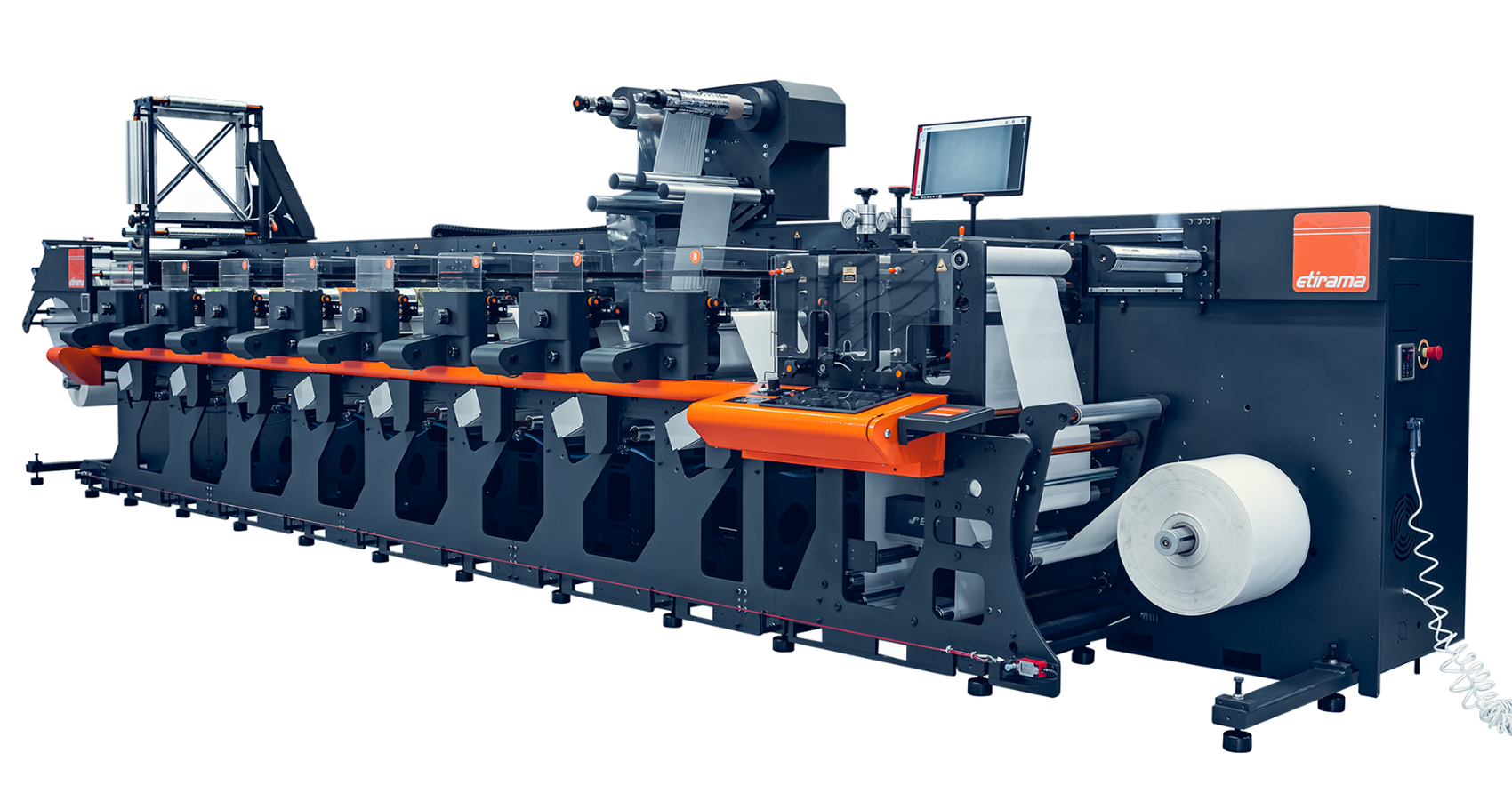
Flexo is right for stable, established designs that run long. Plates cost money once, then spread across every metre printed, and narrow-web flexo presses typically run several times faster than digital. Flexo also prints on a very wide range of papers, films and foils, with finishing inline. Narrow-web flexo is by far the most widely used process for self-adhesive labels worldwide [8].
Flexo remains the workhorse of packaging. Market researcher Smithers puts flexo at 52.6% of global packaging and label print output in 2024 [1]. Smithers also notes that strong sales of hybrid presses, flexo with digital units inline, keep flexo volumes growing [3].
When is offset the right choice?
Offset is right when image detail and smooth tonal gradation decide the sale. It delivers the finest dots and unrestricted tonal values, which is why premium wine, spirits and cosmetics labels, folding cartons and books often go offset [7]. Offset plates also cost less than flexo plates, and variable-size sleeve systems have made narrow-web offset viable on small to mid-size label runs [7].
Smithers estimates offset litho at 17.9% of packaging and label print volume, used mainly where graphics quality matters most, on folding cartons and flexible packaging [1].
What about gravure and screen?
Gravure prints from engraved metal cylinders. It gives excellent, very consistent quality, but cylinders are the most expensive tooling of all, so gravure pays off only on very long, stable runs, mostly wide-web flexible packaging [8]. Smithers puts gravure at 20.1% of packaging and label print volume [1]. On environmental footprint, a life cycle assessment commissioned by plate maker DuPont found flexo with 51% lower global warming potential than gravure [13].
Screen printing pushes the heaviest ink layer through a mesh. Converters use it for opacity, texture, tactile and metallic effects, often as an embellishment step rather than the main print process.
Where is the break-even between digital and flexo?
The break-even is the run length where flexo's set-up cost has been spread thin enough for its lower running cost to win. Industry studies place it roughly between 1,200 and 3,000 linear metres for a typical narrow-web label [4]. It moves with every job: more colours and plates push it up, simpler jobs and reused plates pull it down.
You can calculate it per job:
Break-even run length = (flexo set-up cost minus digital set-up cost) ÷ (digital cost per metre minus flexo cost per metre)
The crossover has also moved over time. A 1998 cost study by a Flexographic Technical Association committee with Indigo put it at about 3,500 feet (about 1,070 m) for four-colour labels; later estimates moved it to about 5,000 feet (about 1,520 m) as digital got faster and cheaper to run [15]. In real production, FINAT's 2019 RADAR survey recorded average runs of about 911 linear metres on digital presses against about 8,177 on conventional presses [4].
Is digital replacing flexo?
No. Digital is taking the short, variable work, while flexo keeps the long runs. Smithers estimates digital at only 1.3% of all printed packaging and label volume in 2025, but 4.1% of value, rising to 5.8% of value by 2030. Labels are furthest ahead: digital already holds about 23.3% of label print value [2].
The Flexographic Technical Association describes the two as complementary rather than competing, whether on separate presses or combined in a hybrid line [5][6]. Converters increasingly frame the task as placing the right job on the right press [14].
How do you choose the right route for your job?
Start from your jobs, not from a machine. Six questions decide most cases:
- How long is each run, per SKU, not on average?
- How often does the design change?
- Does any label carry variable data: serial numbers, codes, names, languages?
- Which substrate, and does it need food-contact compliance? In Europe, inks for food contact materials follow the EuPIA guideline and good manufacturing practice [11][12].
- Which finishing: foil, varnish, die-cutting, embellishment?
- Do you want to own capacity, or access it without heavy capital?
INNVESTIO Group is technology-agnostic by design. We work with Xeikon (Flint Group) for digital, ETIRAMA for narrow-web flexo and Miyakoshi for offset, and we architect the route your operation needs, not the one we happen to stock. If your job belongs on gravure or screen, we will tell you that too.
Not sure which route fits? Tell us about your jobs and we will come back with a way through, not a sales pitch.
[Talk to us Print, Packaging & Food Ingredient Solutions | INNVESTIO Group ]
Frequently asked questions
Is digital printing cheaper than flexo? For short runs, yes, because digital has no plates or long set-up. For long runs, flexo is usually cheaper per label. The crossover typically sits between about 1,200 and 3,000 linear metres, depending on the job.
Can digital printing replace flexo for short runs? Yes. Short, variable and frequently changing jobs are where digital is most often chosen over flexo. Long, stable runs usually stay on flexo.
Which printing method gives the best image quality? Offset and gravure give the finest detail and the most consistent tones. Modern digital and flexo deliver good, consistent colour for most label and packaging work.
Which printing method is best for food labels? Any of the main methods can print food labels, provided the inks or toners and the substrate are documented as compliant for the specific food-contact application. Always check the compliance documentation for your use case.
Can one press do both flexo and digital? Yes. Hybrid presses combine flexo units with digital print units in one line, so stable elements print flexo and variable elements print digitally in a single pass.
References
Market research
- Smithers, The Future of Package Printing to 2029, as reported by Digital Labels & Packaging. https://www.dlpmag.com/?p=76610
- Smithers, The Future of Digital Print for Packaging to 2030, as reported by Labels & Labeling. https://www.labelsandlabeling.com/labels/news/market-trends/digital-packaging-print-reach-369-billion-usd
- Smithers, The Future of Flexographic Printing Markets to 2029, summary, March 2025. https://prd-b4f.smithers.com/resources/2025/march/packaging-powers-expansion-in-flexo-print-to-2029
- FINAT RADAR 2019 run-length data and published break-even studies, as summarised by Codimag. https://codimag.com/en/technology/digital-or-flexo/
Industry associations and education
- Flexographic Technical Association, "Finding the Right Label Printer: Flexo, Digital or Hybrid". https://www.flexography.org/industry-news-iq/digital-flexo-hybrid/
- Flexographic Technical Association, "The Evolution of Flexographic/Digital Hybrid Presses". https://www.flexography.org/industry-news/the-evolution-of-flexographic-digital-hybrid-presses/
- Label Academy (Labels & Labeling), "Print processes: lithographic printing". https://www.labelsandlabeling.com/label-academy/article/print-processes-lithographic-printing
- Label Academy (Labels & Labeling), "Applications for print security" (print process overview). http://www.labelsandlabeling.com/label-academy/article/applications-print-security
White papers and guidelines
- Xeikon, white paper Digital label printing technologies: No one size fits all. Download offered at https://xeikon.com/en/blog/wine-spirits-label-printing-this-is-how-its-done
- Xeikon, white paper on migration-optimised digital label and packaging printing (2021), announced via WhatTheyThink. https://whattheythink.com/news/104535-xeikon-white-paper-migration-optimized-digital-label-packaging-printing-solutions/
- EuPIA (European Printing Ink Association), Guideline on Printing Inks applied to Food Contact Materials (2023). https://www.eupia.org/wp-content/uploads/2023/06/2023-05-18_EuPIA-Guideline-on-Printing-Inks-applied-to-Food-Contact-Materials.pdf
- EuPIA, Good Manufacturing Practice (GMP) Printing Inks for Food Contact Materials, 5th version (November 2025). https://www.eupia.org/wp-content/uploads/2025/11/2025-11-05_EuPIA_GMP_5th_version.pdf
- DuPont, Life Cycle Assessment: Flexographic Printing and Platemaking Update (manufacturer-commissioned). https://www.dupont.com/content/dam/dupont/amer/us/en/cyrel/Public/documents/en/EI00433-2024%20Flexo%20LCA%20Public%20Report%20Update-Final.pdf
Trade press and technical data
- Label and Narrow Web, "Addressing the convergence with flexo, digital, and hybrid label printing" (2026). https://www.labelandnarrowweb.com/exclusives/addressing-the-convergence-with-flexo-digital-and-hybrid-label-printing/
- FTA and Indigo 1998 label cost study, as summarised by VFTL (secondary source). https://vftl.com/digital-label-printing-vs-flexographic-label-printing/
- Xeikon, product range and press specifications. https://xeikon.com/en/products